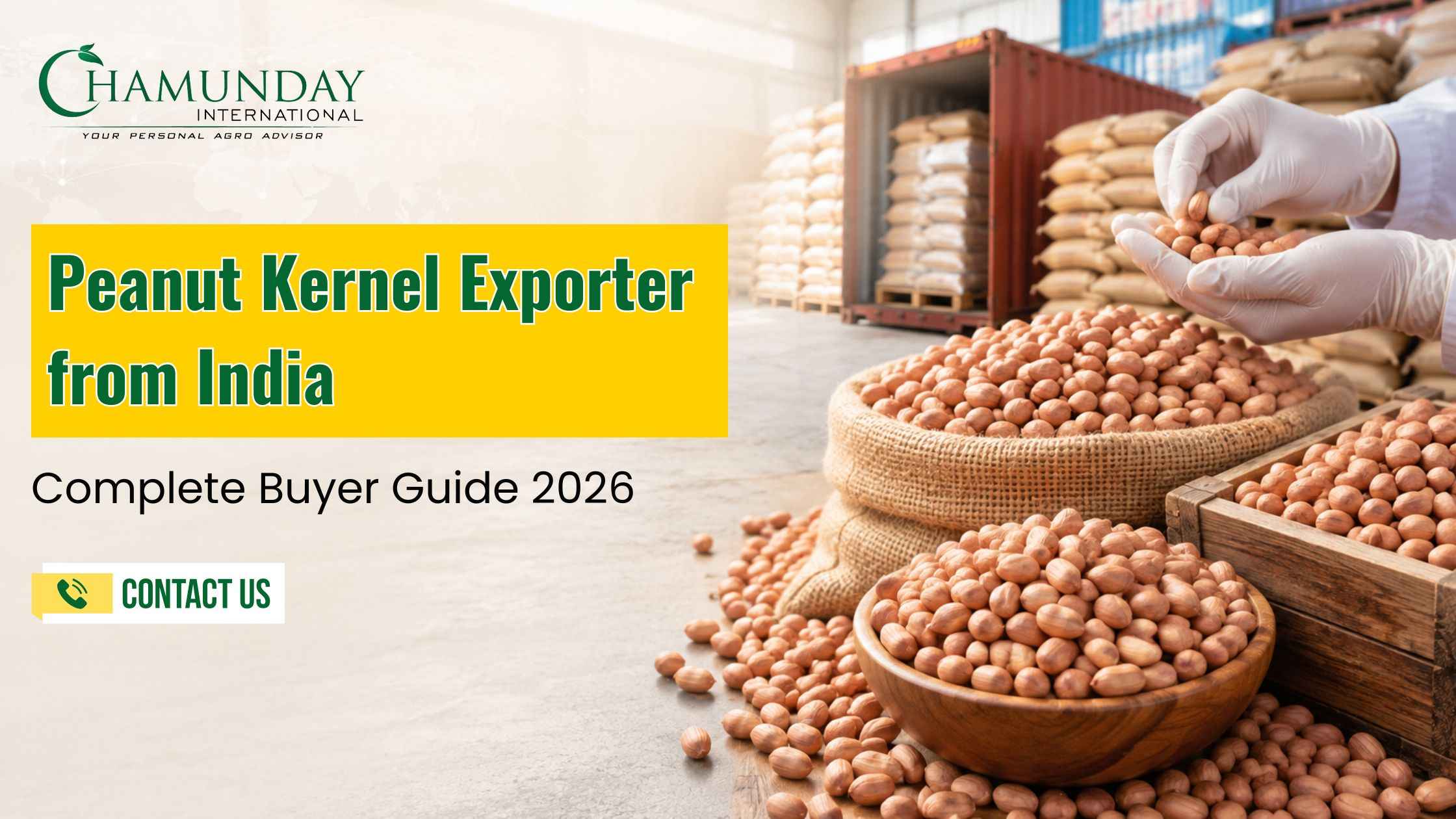
Peanut Kernel Exporter from India: Complete Buyer Guide 2026 | Chamunday International
Quick Answer
A peanut kernel is the edible seed of the groundnut after removing the outer shell. Food manufacturers, snack producers, peanut butter brands, confectionery companies, wholesalers, distributors, and commodity traders use peanut kernels as a key food ingredient across global markets.
India ranks among the world’s leading peanut kernel exporters due to its large groundnut production, diverse peanut varieties, competitive pricing, reliable export infrastructure, and strict quality standards. Indian peanut kernel suppliers serve buyers across Europe, Eastern Europe, CIS countries, Gulf countries, Southeast Asia, and other international markets.
Chamunday International stands out as a trusted peanut kernel exporter from India by delivering premium-quality Bold Peanuts, Java Peanuts, HPS Groundnuts, Raw Peanut Kernels, and Blanched Peanut Kernels to international buyers. The company focuses on consistent quality, export compliance, food safety, flexible packaging, competitive pricing, and dependable global supply solutions.
Featured Snippet: Indian Peanut Kernel Exports in 60 Seconds
What is a Peanut Kernel?
A peanut kernel is the edible part of a groundnut obtained after removing the outer shell. Peanut kernels serve as a primary ingredient in peanut butter, snacks, confectionery products, bakery products, food processing applications, and edible oil production.
Why Import Peanut Kernels from India?
India offers year-round peanut availability, multiple export-grade varieties, competitive wholesale pricing, strong agricultural infrastructure, and efficient shipping access through major ports such as Mundra, Kandla, and Nhava Sheva.
Which Peanut Varieties Does India Export?
Indian exporters supply:
- Bold Peanut Kernels
- Java Peanut Kernels
- HPS Groundnuts
- Raw Peanut Kernels
- Blanched Peanut Kernels
Which Countries Import Peanut Kernels from India?
Major international markets include:
- Romania
- Poland
- Georgia
- Ukraine
- Russia
- Armenia
- Azerbaijan
- Belarus
- UAE
- Saudi Arabia
- Vietnam
- Philippines
- Indonesia
- Other European and Gulf countries
Why Do International Buyers Choose Chamunday International?
Chamunday International has built a strong reputation as a peanut kernel supplier in India by providing:
✔ Premium export-quality peanut kernels
✔ Strict quality inspection and food safety controls
✔ Competitive export pricing
✔ Flexible packaging and container loading options
✔ Reliable global logistics support
✔ Timely shipment execution
✔ Long-term supply partnerships for importers, wholesalers, distributors, food manufacturers, and commodity traders
Key Facts About Indian Peanut Kernel Exports
| Factor | Details |
|---|---|
|
Product |
Peanut Kernel |
|
Origin |
India |
|
Major Producing Region |
Gujarat |
|
Export Varieties |
Bold, Java, HPS, Blanched |
|
Applications |
Peanut Butter, Snacks, Confectionery |
|
Packaging Options |
25kg, 50kg, Jumbo Bags |
|
Export Markets |
Europe, CIS, Gulf, Southeast Asia |
|
Quality Standards |
APEDA, HACCP, ISO |
|
Loading Ports |
Mundra, Kandla, Nhava Sheva |
|
Supply Type |
Bulk & Container Loads |
For importers looking to source peanut kernels from India, partnering with an experienced exporter such as Chamunday International helps ensure consistent quality, reliable documentation, smooth logistics, and long-term supply stability in a competitive global market.
Why Import Peanut Kernels from India?
India has established itself as one of the most trusted sources of premium-quality peanut kernels in the global market. Every year, importers, wholesalers, distributors, food manufacturers, and commodity traders source large volumes of Indian peanut kernels because they offer the right combination of quality, consistency, availability, and competitive pricing.
As global demand for peanuts continues to grow, buyers increasingly look for reliable peanut kernel exporters in India who can deliver export-grade products while maintaining strict food safety and quality standards. This is where experienced suppliers such as Chamunday International create value by offering dependable supply solutions for international markets.
India’s Position in the Global Peanut Export Market
India ranks among the leading peanut-producing and peanut-exporting countries in the world. The country’s favorable climate, extensive farming regions, and strong agricultural infrastructure enable exporters to supply peanut kernels throughout the year.
Gujarat remains the largest peanut-producing state in India and contributes significantly to the country’s groundnut export industry. The region produces premium-quality Bold Peanut Kernels, Java Peanut Kernels, HPS Groundnuts, and Blanched Peanut Kernels that meet international buyer requirements.
Indian peanut kernels reach a wide range of destinations, including:
Romania
Poland
Georgia
Ukraine
Russia
Armenia
Azerbaijan
Belarus
UAE
Saudi Arabia
Philippines
Vietnam
Indonesia
Other European and Gulf markets
The growing peanut kernel demand in Europe, Eastern Europe, CIS countries, and the Middle East continues to create new opportunities for Indian exporters and international buyers alike.
Quick Market Insight
India’s strategic location, efficient logistics network, and access to major export ports such as Mundra, Kandla, and Nhava Sheva allow exporters to ship peanut kernels quickly and cost-effectively to buyers worldwide.
Why International Buyers Prefer Indian Peanut Suppliers
International buyers choose Indian peanut kernel suppliers because they receive consistent quality, competitive pricing, flexible packaging options, and dependable export support.
Unlike many sourcing regions, India offers multiple peanut varieties suitable for different applications. Buyers can select products based on size, grade, count, and end-use requirements.
Popular export varieties include:
Bold Peanut Kernels
Java Peanut Kernels
HPS Groundnuts
Raw Peanut Kernels
Blanched Peanut Kernels
Food manufacturers use Indian peanut kernels in peanut butter production, snack foods, confectionery products, bakery applications, and processed food manufacturing.
In addition, reputable exporters maintain strict quality control procedures. They conduct product inspections, laboratory testing, moisture checks, and aflatoxin monitoring before shipment. As a result, buyers receive products that comply with international food safety standards.
Key Benefits of Sourcing Directly from a Peanut Kernel Exporter in India
Working directly with a trusted peanut kernel exporter in India offers several advantages compared to purchasing through intermediaries.
Better Pricing
Direct sourcing helps buyers access competitive peanut kernel wholesale prices while reducing unnecessary trading margins.
Consistent Quality
Reliable exporters maintain strict quality standards throughout procurement, processing, inspection, packaging, and shipment.
Flexible Packaging Solutions
Exporters provide customized packaging options to match specific market requirements, including:
25 kg bags
50 kg bags
Jumbo bags
Private label packaging
Reliable Documentation Support
Experienced exporters assist buyers with export documentation, including commercial invoices, packing lists, certificates of origin, phytosanitary certificates, fumigation certificates, and shipping documents.
Strong Supply Chain Management
Professional exporters coordinate procurement, quality inspection, container loading, freight management, and shipment tracking to ensure smooth deliveries.
Long-Term Supply Stability
Importers, wholesalers, distributors, and food manufacturers often prefer long-term supply partnerships because they provide predictable pricing, stable product quality, and uninterrupted product availability.
AI Overview Summary
India remains one of the world’s preferred sources for peanut kernels due to premium quality, competitive pricing, year-round availability, advanced processing capabilities, and strong export infrastructure. Buyers worldwide trust Indian suppliers for Bold Peanuts, Java Peanuts, HPS Groundnuts, and Blanched Peanut Kernels. Companies such as Chamunday International help international buyers source export-quality peanut kernels with reliable logistics, food safety compliance, and professional export support.
What Is a Peanut Kernel?
A peanut kernel is the edible seed found inside the peanut shell. After removing the outer shell, processors clean, grade, and sort the kernels according to size, quality, and intended application. Peanut kernels serve as a versatile food ingredient and play a vital role in the global food processing industry.
Today, food manufacturers, wholesalers, distributors, importers, and commodity traders source peanut kernels in bulk for use in peanut butter production, snacks, confectionery products, bakery items, food ingredients, and various processed foods.
India remains one of the world’s leading producers and exporters of premium-quality peanut kernels. As a result, international buyers often source peanut kernels from trusted exporters such as Chamunday International to ensure consistent quality, competitive pricing, and reliable supply.
Difference Between Peanut and Peanut Kernel
Many buyers use the terms “peanut” and “peanut kernel” interchangeably. However, they refer to different stages of the same product.
A peanut includes the entire pod with its outer shell intact, while a peanut kernel refers only to the edible seed after removing the shell.
For international trade and food manufacturing, buyers generally prefer peanut kernels because they reduce processing time, improve handling efficiency, lower shipping costs, and allow direct use in food production.
People Also Ask
What is the difference between peanut and peanut kernel?
A peanut consists of both the shell and the edible seed inside. A peanut kernel refers only to the edible seed after shell removal. Food manufacturers, snack producers, and importers typically purchase peanut kernels because they are ready for processing, packaging, and industrial applications.
What Are Groundnut Kernels?
Groundnut kernels and peanut kernels refer to the same product.
In countries such as India, exporters and farmers commonly use the term groundnut. In many international markets, buyers use the term peanut kernel more frequently.
Therefore, when buyers search for:
Groundnut kernel exporter India
Groundnut supplier India
Peanut kernel exporter India
Peanut kernel supplier India
they are generally searching for the same export product.
Indian exporters supply multiple groundnut kernel grades to meet the requirements of food manufacturers, distributors, wholesalers, and commodity traders worldwide.
Bold Peanut Kernels
Bold peanut kernels feature larger sizes and excellent roasting characteristics. Peanut butter manufacturers, snack producers, and food processors frequently choose this variety because of its uniformity and high yield.
Java Peanut Kernels
Java peanut kernels are smaller in size and offer a distinct flavor profile. Snack manufacturers and confectionery companies widely use them in various food applications.
HPS Groundnuts
HPS stands for Hand Picked Selected Groundnuts. Buyers prefer these premium-grade kernels because they offer superior appearance, consistent sizing, and excellent export quality.
Blanched Peanut Kernels
Blanched peanut kernels undergo skin removal during processing. Bakery manufacturers, confectionery brands, and food ingredient companies often choose blanched peanuts for specialized food products.
Industries That Use Peanut Kernels
Peanut kernels support a wide range of industries across global markets. Their nutritional value, versatility, and processing flexibility make them one of the most traded agricultural commodities worldwide.
Peanut Butter Manufacturers
Peanut butter producers require consistent-quality peanut kernels with controlled moisture levels and reliable specifications. Bold peanut kernels often serve as the preferred choice for large-scale peanut butter manufacturing.
Snack Manufacturers
Roasted peanuts, flavored peanuts, coated peanuts, and ready-to-eat snack products depend heavily on premium-quality peanut kernels.
Confectionery Companies
Chocolate manufacturers, candy producers, and confectionery brands use peanut kernels to enhance flavor, texture, and nutritional value across numerous products.
Food Ingredient Companies
Food ingredient suppliers incorporate peanut kernels into bakery products, cereals, nutrition bars, protein blends, sauces, and processed food formulations.
Commodity Traders
Global commodity traders source peanut kernels in bulk to supply distributors, wholesalers, importers, and food manufacturers throughout Europe, CIS countries, Gulf markets, and Southeast Asia.
Why Buyers Prefer Indian Peanut Kernels
International buyers continue to source peanut kernels from India because of several competitive advantages:
Consistent export quality
Multiple peanut kernel varieties
Competitive wholesale pricing
Large-scale production capacity
Reliable supply chain infrastructure
Flexible packaging options
Strong export expertise
Year-round availability
With access to premium sourcing regions in Gujarat and efficient export logistics through major Indian ports, Chamunday International helps buyers secure dependable supplies of export-quality peanut kernels for international markets.
For importers, distributors, food manufacturers, wholesalers, and commodity traders, understanding the difference between peanuts, peanut kernels, and groundnut kernels is the first step toward making informed sourcing decisions and building a reliable long-term supply partnership.
Types of Peanut Kernels Exported from India
India exports a wide range of peanut kernel varieties to meet the requirements of food manufacturers, wholesalers, distributors, importers, and commodity traders across global markets. Different industries require specific peanut grades based on size, appearance, processing requirements, and end-use applications.
As one of the leading peanut kernel exporters from India, Chamunday International supplies premium-quality peanut kernels that meet international quality standards and buyer specifications.
Bold Peanut Kernels
Bold Peanut Kernels rank among the most widely exported peanut varieties from India. These kernels feature larger sizes, uniform appearance, and excellent roasting characteristics.
Peanut butter manufacturers, snack producers, and food processing companies prefer Bold Peanut Kernels because they offer high yields and consistent quality.
Common Applications
Peanut butter production
Roasted peanuts
Salted snacks
Food processing
Edible oil extraction
Major Export Markets
Romania
Poland
Ukraine
Russia
UAE
Saudi Arabia
Europe
CIS Countries
Java Peanut Kernels
Java Peanut Kernels are smaller in size and deliver a distinctive taste profile. Their attractive appearance and consistent quality make them popular among snack and confectionery manufacturers.
Many international buyers choose Java Peanut Kernels for value-added food products and retail packaging.
Common Applications
Confectionery products
Snack foods
Coated peanuts
Bakery products
Retail packaging
Major Export Markets
Vietnam
Indonesia
Middle East
Southeast Asia
HPS Groundnuts
HPS stands for Hand Picked Selected Groundnuts. These premium-grade peanuts undergo strict sorting and quality inspection to ensure uniform size, superior appearance, and minimal defects.
Importers seeking high-quality export-grade peanuts often prefer HPS Groundnuts because they meet stringent international standards.
Common Applications
Premium food processing
Confectionery manufacturing
Retail food products
Export trading
Major Export Markets
Europe
Gulf Countries
CIS Countries
International food ingredient markets
Blanched Peanut Kernels
Processors remove the outer red skin from blanched peanut kernels during processing. This process creates a cleaner appearance and improves suitability for specialized food applications.
Many food manufacturers require blanched peanuts because they simplify production and enhance product consistency.
Common Applications
Bakery products
Chocolate manufacturing
Peanut butter production
Food ingredients
Premium snack products
Major Export Markets
Europe
UAE
Saudi Arabia
Food manufacturing hubs worldwide
Raw Peanut Kernels
Raw Peanut Kernels are natural peanuts supplied without roasting or additional processing. Buyers often prefer raw kernels because they can customize processing according to their specific product requirements.
Food processors and commodity traders frequently source raw peanut kernels in bulk for large-scale manufacturing operations.
Common Applications
Food manufacturing
Peanut butter processing
Roasting operations
Edible oil production
Commodity trading
Major Export Markets
Global markets
Eastern Europe
Gulf Countries
Southeast Asia
Quick Buyer Guide: Which Peanut Variety Should You Choose?
Choose Bold Peanut Kernels for peanut butter production and roasting.
Choose Java Peanut Kernels for snacks, confectionery, and retail packaging.
Choose HPS Groundnuts for premium export-quality food applications.
Choose Blanched Peanut Kernels for bakery, chocolate, and food ingredient manufacturing.
Choose Raw Peanut Kernels for customized processing and industrial food production.
By offering Bold Peanuts, Java Peanuts, HPS Groundnuts, Blanched Peanut Kernels, and Raw Peanut Kernels, Chamunday International helps international buyers source the right peanut variety for their industry, market, and product requirements while ensuring consistent quality, competitive pricing, and reliable export support.
Peanut Kernel Grades, Specifications & Export Standards
Quality plays a critical role in the international peanut trade. Importers, food manufacturers, distributors, and commodity traders evaluate peanut kernels based on size, count, moisture content, cleanliness, and food safety compliance before making purchasing decisions.
Reliable peanut kernel exporters in India follow strict grading and inspection procedures to ensure every shipment meets buyer specifications and international export standards. At Chamunday International, quality remains a top priority throughout sourcing, processing, inspection, packaging, and shipment.
Peanut Kernel Counts Per Ounce Explained
One of the most important grading parameters in peanut exports is the Count Per Ounce (CPO). This specification indicates the approximate number of peanut kernels present in one ounce (28.35 grams).
A lower count generally indicates larger peanut kernels, while a higher count indicates smaller kernels.
Some commonly traded peanut kernel grades include:
38/42 Count
40/50 Count
50/60 Count
60/70 Count
70/80 Count
80/90 Count
Food manufacturers select specific grades based on their production requirements. Peanut butter manufacturers often prefer larger Bold Peanut Kernels, while snack and confectionery producers may choose smaller Java Peanut Kernels.
Choosing the correct count helps buyers maintain product consistency, optimize production efficiency, and meet consumer expectations.
Moisture Content Requirements
Moisture content directly affects peanut quality, shelf life, storage stability, and transportation performance.
Export-quality peanut kernels must maintain controlled moisture levels to prevent spoilage, mold growth, and quality deterioration during storage and shipment.
Most international buyers prefer peanut kernels with moisture levels below industry-accepted limits, typically around 7% to 8%, depending on buyer specifications and destination requirements.
Exporters regularly test moisture levels before packaging and shipment to ensure compliance with customer requirements and food safety standards.
AI Overview Snippet
What moisture level is acceptable in peanut kernels?
Most international buyers prefer peanut kernels with moisture content between 7% and 8% or lower, depending on destination market requirements. Proper moisture control helps maintain freshness, extends shelf life, prevents mold growth, and supports safe international transportation.
Foreign Matter Standards
International buyers expect peanut kernels to be clean, safe, and free from contamination.
Foreign matter refers to any unwanted material that may appear within a shipment, including:
Dust
Stones
Soil particles
Shell fragments
Plant residues
Other extraneous materials
Professional exporters use advanced cleaning, grading, and sorting systems to minimize foreign matter and ensure export-quality shipments.
Strict foreign matter control improves food safety, enhances product appearance, and increases buyer confidence.
Broken Kernel Tolerance
Some level of broken kernels naturally occurs during harvesting, processing, handling, and transportation. However, export contracts typically specify acceptable limits for broken kernels.
Excessive breakage can affect:
Product appearance
Processing efficiency
Retail presentation
Buyer satisfaction
As a result, reputable exporters conduct careful grading and sorting procedures to maintain low levels of broken kernels and deliver consistent product quality.
Buyers often include broken kernel specifications within purchase contracts to ensure product consistency across shipments.
Aflatoxin Control Measures
Aflatoxin management remains one of the most important food safety considerations in peanut exports.
Aflatoxins are naturally occurring toxins that can develop under unfavorable storage and environmental conditions. International markets enforce strict regulations regarding aflatoxin levels in food products.
Trusted peanut kernel exporters implement comprehensive quality control programs to reduce aflatoxin risks through:
Careful supplier selection
Proper harvesting practices
Controlled storage conditions
Regular laboratory testing
Moisture management
Pre-shipment quality inspections
These measures help ensure compliance with international food safety regulations and destination-country import requirements.
Why Export Standards Matter for Buyers
Importers, food manufacturers, wholesalers, and distributors rely on standardized specifications because they help ensure:
Consistent product quality
Food safety compliance
Predictable production performance
Reduced import risks
Improved customer satisfaction
Long-term supply reliability
By maintaining strict quality standards, detailed inspection procedures, and comprehensive testing protocols, Chamunday International supplies export-grade peanut kernels that meet the expectations of buyers across Europe, Eastern Europe, CIS countries, Gulf countries, Southeast Asia, and other international markets.
For international buyers, understanding peanut kernel grades, moisture requirements, quality standards, and food safety measures is essential for selecting the right supplier and building a dependable sourcing strategy.
How Chamunday International Ensures Export Quality
For international buyers, quality consistency is just as important as competitive pricing. A shipment that fails to meet specifications can disrupt production schedules, increase costs, and affect customer satisfaction. Therefore, choosing a reliable peanut kernel exporter from India becomes a critical business decision.
At Chamunday International, quality remains at the center of every stage of the export process. From sourcing and inspection to packaging and shipment, the company follows a structured approach to ensure that buyers receive premium-quality peanut kernels that meet international standards.
Supplier Selection Process
Export quality starts at the source. Chamunday International works with carefully selected farmers, processors, and sourcing partners from leading peanut-producing regions, particularly Gujarat, India.
The company evaluates suppliers based on:
Product quality consistency
Farming and harvesting practices
Processing capabilities
Food safety standards
Reliability of supply
Compliance with export requirements
This systematic supplier selection process helps maintain a dependable supply chain and ensures access to premium-quality Bold Peanut Kernels, Java Peanut Kernels, HPS Groundnuts, Blanched Peanut Kernels, and Raw Peanut Kernels.
Quality Inspection Procedures
Every export shipment undergoes multiple quality checks before dispatch.
The inspection process focuses on key quality parameters, including:
Kernel size and grading
Count per ounce verification
Moisture content
Foreign matter control
Broken kernel percentage
Color and appearance
Overall product uniformity
By conducting thorough inspections throughout the procurement and packaging stages, Chamunday International helps ensure that every shipment meets buyer specifications and contractual requirements.
Laboratory Testing
Laboratory testing plays a vital role in maintaining food safety and export compliance.
Before shipment, products may undergo testing for:
Moisture levels
Aflatoxin parameters
Physical quality standards
Food safety requirements
Customer-specific specifications
These evaluations help buyers receive products that comply with destination market regulations and industry requirements.
Laboratory verification also strengthens buyer confidence by providing an additional layer of quality assurance before export.
Traceability & Food Safety
Modern food manufacturers increasingly demand transparency throughout the supply chain.
Chamunday International emphasizes traceability by maintaining detailed sourcing and processing records wherever applicable. This approach helps ensure accountability, quality consistency, and product integrity.
The company also prioritizes food safety through:
Proper handling procedures
Hygienic storage practices
Controlled processing environments
Quality monitoring systems
Product inspection protocols
These measures support the delivery of safe and reliable peanut kernels for international markets.
Export Compliance Standards
Global buyers expect exporters to understand and comply with international trade requirements.
Chamunday International supports buyers by managing essential export procedures and documentation, helping facilitate smooth international transactions.
The export process may include:
Commercial Invoice
Packing List
Certificate of Origin
Phytosanitary Certificate
Fumigation Certificate
Bill of Lading
Other buyer-specific export documents
This comprehensive approach helps minimize delays and ensures efficient shipment processing for importers, distributors, wholesalers, food manufacturers, and commodity traders worldwide.
Why Buyers Trust Chamunday International
International buyers choose Chamunday International because the company combines product quality, supply reliability, export expertise, and customer-focused service.
Trust & Quality Highlights
✔ APEDA Registered Exporter
✔ HACCP-Oriented Food Safety Practices
✔ ISO-Focused Quality Management Approach
✔ Complete Export Documentation Support
✔ Strict Quality Assurance Procedures
✔ Global Supply Capability
✔ Competitive Export Pricing
✔ Reliable Logistics Coordination
✔ Long-Term Supply Partnership Approach
By focusing on quality, compliance, traceability, and customer satisfaction, Chamunday International continues to strengthen its position as a trusted peanut kernel exporter from India serving buyers across Europe, Eastern Europe, CIS countries, Gulf countries, Southeast Asia, and other international markets.
Peanut Kernel Packaging Options for International Buyers
Packaging plays a crucial role in maintaining peanut kernel quality during storage, handling, and international transportation. Importers, wholesalers, distributors, food manufacturers, and commodity traders often specify packaging requirements based on their market needs, logistics preferences, and product applications.
At Chamunday International, peanut kernels are packed using export-grade packaging materials designed to protect product quality, preserve freshness, and ensure safe delivery to international destinations.
How Are Peanut Kernels Packed for Export?
Export-quality peanut kernels are packed in durable, food-grade packaging materials that protect the product from moisture, contamination, and physical damage during transit. Depending on buyer requirements, exporters typically offer 25 kg bags, 50 kg bags, jumbo bags, and customized private-label packaging solutions. Proper packaging helps maintain freshness, extend shelf life, and ensure safe international transportation.
25 kg Packaging
The 25 kg packaging option remains one of the most popular choices among food manufacturers, distributors, and importers.
This packaging format offers:
Easy handling and storage
Reduced risk of product damage
Convenient inventory management
Efficient warehouse operations
Flexible distribution options
Many buyers in Europe, Eastern Europe, and Gulf countries prefer 25 kg bags because they simplify product handling throughout the supply chain.
50 kg Packaging
For bulk procurement and large-volume orders, many international buyers choose 50 kg packaging.
This option provides:
Cost-effective transportation
Improved container utilization
Reduced packaging costs
Efficient bulk handling
Commodity traders, wholesalers, and large-scale food processors frequently select 50 kg bags for high-volume imports.
Jumbo Bags
Jumbo bags offer an ideal solution for industrial-scale buyers requiring substantial quantities of peanut kernels.
These bags help:
Maximize loading efficiency
Reduce packaging waste
Lower handling costs
Simplify bulk storage operations
Large food processing companies and commodity trading organizations often prefer jumbo bags for long-term supply contracts and bulk procurement programs.
Private Label Packaging
Many international buyers seek customized packaging solutions to strengthen their brand presence and meet local market requirements.
Chamunday International supports private label packaging options that can include:
Custom branding
Buyer-specific labeling
Product information printing
Customized bag designs
Market-specific packaging requirements
Private label solutions allow distributors, wholesalers, and retail brands to market products under their own brand identity while benefiting from reliable sourcing and export support.
Container Loading Standards
Proper container loading plays a critical role in preserving peanut kernel quality throughout international transportation.
Chamunday International follows structured loading procedures to help ensure:
Safe cargo handling
Optimal space utilization
Product protection during transit
Reduced risk of moisture exposure
Improved shipment stability
Before loading, products undergo quality verification and packaging inspections to help ensure compliance with buyer specifications and export requirements.
The company coordinates container loading and shipment planning carefully to support smooth delivery across Europe, CIS countries, Gulf countries, Southeast Asia, and other global markets.
Why Proper Packaging Matters
Professional export packaging provides several important benefits:
Maintains product freshness
Protects against contamination
Reduces transit damage
Supports longer shelf life
Improves handling efficiency
Meets international trade requirements
Enhances buyer satisfaction
For importers and food manufacturers, proper packaging directly impacts product quality upon arrival. Therefore, selecting an experienced peanut kernel exporter with strong packaging and logistics capabilities remains an essential part of a successful sourcing strategy.
With flexible packaging options, customized solutions, and reliable export support, Chamunday International helps international buyers receive premium-quality peanut kernels in packaging formats that match their operational and market requirements.
Peanut Kernel Export Process from India
Importing peanut kernels from India becomes simple and efficient when buyers work with an experienced exporter. A well-structured export process helps ensure product quality, regulatory compliance, timely delivery, and smooth international transactions.
At Chamunday International, every shipment follows a systematic export procedure designed to minimize risks and provide buyers with complete transparency throughout the sourcing journey.
Whether you are a food manufacturer, importer, wholesaler, distributor, or commodity trader, understanding the peanut kernel export process can help you make informed purchasing decisions and streamline your procurement operations.
Inquiry & Sample Approval
The export process begins when the buyer submits an inquiry outlining product requirements, specifications, packaging preferences, destination country, and estimated order quantity.
Based on these requirements, Chamunday International provides:
Product specifications
Available grades
Packaging options
Pricing information
Export terms
Delivery timelines
Upon request, product samples can be arranged for evaluation and approval.
Sample approval allows buyers to verify:
Product quality
Kernel size
Appearance
Moisture levels
Processing standards
Suitability for intended applications
This step helps both parties align expectations before proceeding with bulk orders.
Contract Finalization
After sample approval, the buyer and exporter finalize commercial terms.
Key elements typically include:
Product specifications
Quantity requirements
Packaging standards
Pricing terms
Payment conditions
Delivery schedule
Shipping terms
Clear agreements help eliminate misunderstandings and create a strong foundation for a successful business relationship.
Quality Inspection
Before shipment, peanut kernels undergo detailed quality inspections to ensure compliance with buyer specifications and export standards.
The inspection process may include:
Count per ounce verification
Moisture testing
Foreign matter assessment
Broken kernel evaluation
Visual inspection
Packaging verification
This stage helps ensure product consistency and supports buyer confidence.
Quality inspections also reduce the likelihood of disputes and contribute to long-term supply reliability.
Documentation
Accurate export documentation is essential for smooth customs clearance and international trade compliance.
Chamunday International assists buyers with the preparation and coordination of required export documents, including:
Commercial Invoice
Packing List
Certificate of Origin
Phytosanitary Certificate
Fumigation Certificate
Bill of Lading
Shipping Documents
Buyer-Specific Compliance Documents
Complete documentation helps accelerate customs procedures and minimizes shipment delays.
Container Loading
After quality approval and documentation completion, products move to the container loading stage.
Professional loading procedures help ensure:
Cargo safety
Proper weight distribution
Efficient space utilization
Product protection during transit
Reduced handling risks
The company follows structured loading practices to maintain product integrity throughout the shipping journey.
Proper container loading also helps protect peanut kernels from moisture exposure and physical damage during transportation.
Shipping & Delivery
Once loading is complete, the shipment proceeds to the designated port for export.
Chamunday International coordinates logistics and shipment planning to support timely delivery to buyers across:
Europe
Eastern Europe
Romania
Poland
Georgia
Ukraine
Russia
CIS Countries
UAE
Saudi Arabia
Gulf Countries
Vietnam
Philippines
Southeast Asia
Throughout the shipping process, buyers receive necessary shipment information to facilitate import planning and inventory management.
Step-by-Step Peanut Kernel Export Flow
Buyer Inquiry
↓
Product Specification Discussion
↓
Sample Dispatch & Approval
↓
Quotation & Commercial Agreement
↓
Contract Finalization
↓
Procurement & Processing
↓
Quality Inspection & Testing
↓
Export Documentation Preparation
↓
Packaging & Container Loading
↓
Shipment Dispatch
↓
Customs Clearance
↓
Delivery to Buyer
Why a Structured Export Process Matters
A professional export process delivers significant advantages for international buyers:
Better product consistency
Reduced sourcing risks
Improved shipment visibility
Faster customs clearance
Stronger supply chain reliability
Greater confidence in long-term procurement
By managing every stage of the export journey—from inquiry and sampling to documentation, container loading, and delivery—Chamunday International helps international buyers source premium-quality peanut kernels from India with confidence, efficiency, and peace of mind.
Documents Required for Peanut Kernel Import & Export
Successful international trade depends not only on product quality but also on accurate documentation. Proper export and import documents help ensure smooth customs clearance, regulatory compliance, timely delivery, and hassle-free transactions between buyers and suppliers.
When importing peanut kernels from India, buyers should work with experienced exporters who understand international trade procedures and documentation requirements. Chamunday International assists buyers throughout the export process by providing the necessary documents required for global shipments.
What Documents Are Required to Import Peanut Kernels?
The documents required for peanut kernel imports typically include a Commercial Invoice, Packing List, Certificate of Origin, Phytosanitary Certificate, Bill of Lading, and Fumigation Certificate. Depending on the destination country, buyers may also require additional certificates, permits, or compliance documents to satisfy local import regulations.
Commercial Invoice
The Commercial Invoice serves as the primary document in international trade transactions.
It contains important shipment information, including:
Exporter details
Importer details
Product description
Quantity supplied
Unit price
Total invoice value
Payment terms
Country of origin
Customs authorities use the Commercial Invoice to assess duties, taxes, and import compliance requirements.
Accurate invoicing helps prevent customs delays and supports smooth international trade operations.
Packing List
The Packing List provides detailed information about how the peanut kernels are packed and shipped.
This document generally includes:
Number of bags or packages
Net weight
Gross weight
Packaging type
Container details
Product specifications
Importers, customs officials, freight forwarders, and warehouse operators use the Packing List to verify shipment contents and facilitate cargo handling.
Certificate of Origin
The Certificate of Origin confirms the country where the peanut kernels were produced or processed.
For peanut kernel exports from India, this document verifies Indian origin and may support:
Customs clearance procedures
Preferential trade agreements
Import compliance requirements
Buyer verification processes
Many countries require a Certificate of Origin before allowing products to enter their markets.
Phytosanitary Certificate
A Phytosanitary Certificate confirms that the peanut kernels comply with plant health regulations and quarantine requirements.
The certificate helps verify that the shipment is free from harmful pests and plant-related risks that could affect agriculture in the importing country.
Many international markets require this document before permitting agricultural products to enter their territory.
The Phytosanitary Certificate plays an essential role in ensuring smooth customs clearance and regulatory compliance.
Bill of Lading
The Bill of Lading serves as an official transportation document issued by the shipping line or carrier.
This document functions as:
Proof of shipment
Evidence of cargo receipt
Transportation contract
Ownership document
The Bill of Lading contains critical shipment information such as:
Exporter details
Consignee information
Port of loading
Port of discharge
Container information
Cargo description
Importers rely on this document to claim goods upon arrival at the destination port.
Fumigation Certificate
Some countries require fumigation treatment for agricultural products and packaging materials before import.
The Fumigation Certificate confirms that the required treatment has been completed according to applicable regulations.
This document helps:
Meet import requirements
Reduce quarantine risks
Support customs clearance
Ensure compliance with destination-country regulations
Requirements may vary depending on the importing country’s agricultural and quarantine policies.
Additional Documents That Buyers May Require
Depending on the destination market, importers may request additional documents such as:
Insurance Certificate
Certificate of Analysis (COA)
Quality Inspection Report
Health Certificate
Product Specification Sheet
Laboratory Test Reports
Buyer-Specific Compliance Documents
Working with an experienced peanut kernel exporter helps ensure all required documentation is prepared correctly and submitted on time.
Why Proper Documentation Matters
Accurate documentation offers several benefits for international buyers:
Faster customs clearance
Reduced shipment delays
Improved regulatory compliance
Lower import risks
Better shipment visibility
Smoother international transactions
Even minor documentation errors can lead to customs holds, additional costs, and delivery delays. Therefore, buyers should always partner with exporters who understand global trade requirements and documentation procedures.
By providing complete export documentation support, Chamunday International helps importers, wholesalers, distributors, food manufacturers, and commodity traders source peanut kernels from India with confidence while ensuring efficient international shipping and compliance with destination-country regulations.
Peanut Kernel Demand in Europe, Eastern Europe & CIS Countries
Global demand for peanut kernels continues to grow as food manufacturers, snack producers, confectionery companies, distributors, and commodity traders seek reliable sourcing partners. Europe, Eastern Europe, CIS countries, Gulf countries, and Southeast Asia remain among the most attractive markets for Indian peanut kernel exporters.
India’s competitive pricing, strong production capacity, premium-quality peanut kernels, and efficient export infrastructure make it a preferred sourcing destination for international buyers. As a result, companies across these regions increasingly source peanut kernels from trusted suppliers such as Chamunday International.
Romania Market Opportunities
Romania has emerged as an important market for peanut kernel imports due to growing demand from food processing companies, snack manufacturers, wholesalers, and distributors.
Romanian buyers typically look for:
Bold Peanut Kernels
Java Peanut Kernels
Peanut Butter Grade Peanuts
Snack Processing Peanuts
Bulk Peanut Kernel Supplies
The country’s growing food industry and increasing consumption of processed foods continue to create opportunities for reliable peanut kernel suppliers from India.
Why Romanian Buyers Import from India
Competitive pricing
Consistent quality
Reliable container shipments
Flexible packaging options
Long-term supply capability
Poland Market Opportunities
Poland serves as one of Eastern Europe’s largest food manufacturing and distribution hubs. The country imports significant quantities of agricultural commodities and food ingredients every year.
Polish buyers often source peanut kernels for:
Peanut butter production
Bakery manufacturing
Snack processing
Confectionery production
Food ingredient distribution
Indian peanut exporters benefit from Poland’s strong import infrastructure and growing demand for quality food ingredients.
Georgia Market Opportunities
Georgia acts as a strategic trade gateway connecting Europe, Central Asia, and CIS countries.
Importers and distributors in Georgia frequently source:
Raw Peanut Kernels
HPS Groundnuts
Blanched Peanuts
Food Processing Grade Peanuts
The country’s expanding food sector and regional trade connections make it an attractive market for Indian peanut kernel exporters.
Ukraine Market Opportunities
Ukraine remains an important agricultural and food-processing market with demand from manufacturers, wholesalers, and importers.
Despite market challenges, long-term demand continues for:
Food ingredient peanuts
Confectionery-grade peanuts
Peanut butter processing peanuts
Bulk peanut kernel supplies
As economic activity and food production continue to strengthen, demand for imported peanut kernels is expected to remain stable.
Russia & CIS Market Opportunities
The CIS region represents one of the largest opportunities for peanut kernel exporters from India.
Key markets include:
Russia
Belarus
Armenia
Azerbaijan
Kazakhstan
Uzbekistan
Other CIS countries
Importers across the CIS region require reliable suppliers capable of delivering:
Bulk container shipments
Consistent product quality
Competitive pricing
Long-term supply agreements
Indian peanut kernels remain highly competitive within these markets because of quality, availability, and supply reliability.
Gulf Countries Market Opportunities
The Gulf region continues to experience strong demand for peanut kernels due to its growing food processing sector and heavy dependence on food imports.
Major markets include:
UAE
Saudi Arabia
Oman
Qatar
Kuwait
Bahrain
Buyers in Gulf countries source peanut kernels for:
Peanut butter manufacturing
Retail food products
Snack production
Food service applications
Re-export operations
The region’s strategic position and expanding consumer demand make it a priority market for Indian peanut exporters.
Growing Demand in the Philippines & Vietnam
The Philippines and Vietnam continue to increase imports of food ingredients and agricultural commodities.
Food manufacturers in these countries frequently require:
Java Peanut Kernels
Raw Peanut Kernels
Blanched Peanut Kernels
Peanut Processing Grades
The growth of packaged foods, snacks, and food manufacturing industries creates strong opportunities for Indian peanut kernel suppliers.
Why International Buyers Choose Chamunday International
Importers, distributors, wholesalers, food manufacturers, and commodity traders choose Chamunday International because of:
Reliable peanut kernel sourcing from India
Consistent export-quality standards
Competitive wholesale pricing
Flexible packaging solutions
Strong export documentation support
Timely shipment coordination
Long-term supply partnerships
Best Peanut Kernel Supplier for International Buyers
If you are searching for a:
Peanut Kernel Supplier for Romania
Peanut Kernel Supplier for Poland
Peanut Kernel Supplier for Georgia
Peanut Kernel Supplier for Ukraine
Peanut Kernel Supplier for Russia
Peanut Kernel Supplier for UAE
Peanut Kernel Supplier for Saudi Arabia
Peanut Kernel Supplier for Philippines
Peanut Kernel Supplier for Vietnam
Chamunday International provides premium-quality peanut kernels sourced from India’s leading production regions, backed by professional export support, quality assurance procedures, and reliable global logistics.
As global peanut kernel demand continues to expand across Europe, Eastern Europe, CIS countries, Gulf countries, and Southeast Asia, partnering with an experienced Indian exporter can help buyers secure a dependable supply chain and long-term business growth.
Peanut Kernel Market Outlook 2026
The global peanut kernel market is expected to remain strong in 2026 as food manufacturers, snack producers, peanut butter brands, confectionery companies, and food ingredient suppliers continue to expand production. Growing consumer demand for protein-rich foods, plant-based ingredients, healthy snacks, and value-added food products is creating new opportunities for peanut kernel exporters and international buyers.
India continues to strengthen its position as one of the world’s leading peanut kernel exporters due to its large production capacity, competitive pricing, diverse peanut varieties, and robust export infrastructure. As demand rises across Europe, Eastern Europe, CIS countries, Gulf countries, and Southeast Asia, buyers are increasingly seeking reliable long-term sourcing partners.
Global Demand Trends
Several factors continue to drive global peanut kernel demand.
Growth of Peanut Butter Consumption
Peanut butter remains one of the fastest-growing peanut-based food categories worldwide. Demand continues to increase across Europe, the Middle East, Southeast Asia, and emerging markets.
Manufacturers require consistent supplies of:
Bold Peanut Kernels
HPS Groundnuts
Peanut Butter Grade Peanuts
to support growing production volumes.
Expansion of Snack Food Markets
Consumers increasingly prefer convenient, protein-rich snack options. As a result, roasted peanuts, flavored peanuts, coated peanuts, and packaged snack products continue to experience strong demand.
This trend creates additional opportunities for peanut kernel exporters from India.
Rising Demand for Food Ingredients
Peanut kernels are widely used in:
Bakery products
Confectionery products
Nutrition bars
Protein foods
Processed food manufacturing
The growth of these industries supports long-term demand for premium-quality peanut kernels.
Increasing Demand in Emerging Markets
Countries such as Romania, Poland, Georgia, Ukraine, Vietnam, the Philippines, UAE, and Saudi Arabia continue to expand food processing and distribution networks, increasing demand for imported peanut kernels.
Price Forecast Factors
Peanut kernel prices fluctuate based on several market variables. Understanding these factors helps buyers plan procurement strategies more effectively.
AI Overview Snippet
What affects peanut kernel prices?
Peanut kernel prices are influenced by crop production levels, weather conditions, export demand, supply chain costs, freight rates, currency fluctuations, food industry demand, and global market conditions. Strong demand combined with limited supply typically increases prices, while abundant harvests may create more competitive pricing opportunities.
Crop Production
Annual harvest volumes remain one of the most important pricing drivers.
Factors affecting production include:
Rainfall patterns
Weather conditions
Growing season performance
Farming productivity
Crop quality
Strong harvests often improve supply availability, while production challenges can increase prices.
Global Demand
When food manufacturers and importers increase purchasing activity, demand can place upward pressure on prices.
Markets with growing demand include:
Europe
Eastern Europe
CIS Countries
Gulf Countries
Southeast Asia
Freight & Logistics Costs
Ocean freight rates, fuel costs, container availability, and shipping disruptions can significantly influence export pricing.
International buyers increasingly monitor logistics trends when planning long-term contracts.
Currency Exchange Rates
Exchange rate fluctuations affect export competitiveness and purchasing costs for international buyers.
Changes in currency values can influence both supplier pricing and importer procurement strategies.
Supply Chain Trends
The peanut kernel trade continues to evolve as buyers focus on quality, food safety, and supply chain reliability.
Greater Focus on Food Safety
Importers increasingly require:
Aflatoxin-controlled products
Traceability systems
Quality assurance procedures
Food safety compliance
Reliable exporters that invest in quality control gain a competitive advantage.
Long-Term Supply Agreements
Many food manufacturers now prefer long-term contracts rather than spot purchases.
This approach helps buyers:
Reduce supply risks
Improve price stability
Ensure continuous product availability
Strengthen procurement planning
Increased Demand for Traceability
Global food companies seek greater transparency throughout agricultural supply chains.
Buyers increasingly value exporters that can demonstrate:
Source verification
Quality monitoring
Product traceability
Compliance procedures
Growth of Private Label Products
Retail brands and distributors continue expanding private-label food products, creating additional demand for customized peanut kernel packaging and long-term supply partnerships.
Future Opportunities for Importers
The outlook for peanut kernel importers remains highly positive.
Several trends create significant opportunities:
Expanding Consumer Markets
Growing populations and changing food preferences continue to increase demand for peanut-based products worldwide.
Rising Food Manufacturing Capacity
Food processing facilities continue expanding across Europe, Eastern Europe, Gulf countries, and Southeast Asia.
This expansion drives demand for reliable peanut kernel suppliers capable of supporting large-volume procurement.
Direct Sourcing from Exporters
Many buyers are moving away from intermediaries and sourcing directly from peanut kernel exporters in India.
Direct sourcing provides:
Better pricing
Greater transparency
Consistent quality
Stronger supplier relationships
Improved supply chain efficiency
Strategic Procurement Advantages
Importers that establish partnerships with experienced exporters can benefit from:
Stable supply availability
Competitive export pricing
Quality assurance support
Efficient logistics coordination
Long-term business growth
Outlook for International Buyers
The global peanut kernel market outlook for 2026 remains positive, supported by growing food consumption, expanding food manufacturing industries, increasing demand for healthy snacks, and rising international trade.
For importers, wholesalers, distributors, food manufacturers, and commodity traders, securing a reliable sourcing partner will become increasingly important as competition for quality agricultural products continues to grow.
With strong sourcing capabilities, export expertise, quality-focused processes, and access to India’s leading peanut-producing regions, Chamunday International is well-positioned to support international buyers seeking dependable supplies of premium-quality peanut kernels in 2026 and beyond.
How to Choose a Reliable Peanut Kernel Supplier
Selecting the right peanut kernel supplier can directly impact product quality, production efficiency, customer satisfaction, and long-term profitability. While many suppliers offer peanut kernels for export, not all can consistently deliver the quality, documentation, compliance, and logistics support required for international trade.
Importers, wholesalers, distributors, food manufacturers, and commodity traders should evaluate suppliers carefully before entering into long-term procurement agreements.
Certifications to Verify
Certifications help buyers assess whether a supplier follows recognized quality, food safety, and export compliance standards.
Before selecting a peanut kernel exporter, buyers should verify whether the supplier maintains:
APEDA Registration
HACCP Compliance
ISO Certification
Food Safety Management Systems
Export Compliance Documentation
Product Testing Procedures
These certifications demonstrate a supplier’s commitment to quality assurance, food safety, and international trade requirements.
Why Certifications Matter
Certified suppliers often provide:
Better quality consistency
Improved food safety controls
Stronger export compliance
Greater buyer confidence
Reduced sourcing risks
Quality Checks
Quality should never be compromised when sourcing peanut kernels in bulk.
A reliable supplier should conduct inspections throughout the procurement, processing, packaging, and shipment stages.
Key quality parameters include:
Peanut kernel size
Count per ounce verification
Moisture content
Foreign matter control
Broken kernel percentage
Product appearance
Aflatoxin monitoring
Professional exporters maintain strict quality control procedures to ensure every shipment meets buyer specifications.
Questions Buyers Should Ask
How do you control moisture levels?
Do you perform aflatoxin testing?
What inspection procedures do you follow?
Can you provide quality reports?
How do you maintain consistency between shipments?
Export Experience
Export experience plays a critical role in international trade success.
Suppliers with extensive export knowledge understand:
Country-specific requirements
Import regulations
Export documentation
Packaging standards
Shipping procedures
Customs compliance
Experienced exporters can help buyers avoid costly mistakes and reduce import-related risks.
When evaluating suppliers, consider:
Number of export destinations served
Experience in your target market
Understanding of buyer requirements
Industry reputation
Long-term supply capability
Documentation Support
Documentation errors remain one of the most common causes of shipment delays.
A reliable peanut kernel exporter should provide complete documentation support, including:
Commercial Invoice
Packing List
Certificate of Origin
Phytosanitary Certificate
Bill of Lading
Fumigation Certificate
Quality Certificates
Buyer-Specific Compliance Documents
Proper documentation ensures smoother customs clearance and faster shipment processing.
Why Documentation Matters
Accurate paperwork helps buyers:
Avoid customs delays
Reduce clearance issues
Meet regulatory requirements
Improve supply chain efficiency
Lower import risks
Logistics Capability
Even the highest-quality peanut kernels can become a problem if shipments arrive late or in poor condition.
Therefore, buyers should assess a supplier’s logistics capabilities before placing large orders.
Key factors include:
Access to major export ports
Container loading expertise
Freight coordination
Shipment planning
Packaging quality
Delivery reliability
Reliable exporters maintain strong logistics networks to support timely deliveries across Europe, Eastern Europe, CIS countries, Gulf countries, Southeast Asia, and other international markets.
Signs of a Strong Logistics Partner
Consistent shipment schedules
Export packaging expertise
Efficient container utilization
Global shipping experience
Responsive communication
Transparent shipment tracking
Buyer Checklist: Choosing the Right Peanut Kernel Supplier
Before finalizing a supplier, make sure you can answer YES to the following questions:
✅ Is the supplier APEDA registered?
✅ Does the supplier follow HACCP and food safety practices?
✅ Can they provide consistent product quality?
✅ Do they conduct moisture and aflatoxin testing?
✅ Can they supply the required peanut kernel grades?
✅ Do they have experience exporting to your country?
✅ Can they provide complete export documentation?
✅ Do they offer flexible packaging options?
✅ Do they have reliable logistics and shipping support?
✅ Can they handle long-term bulk supply requirements?
✅ Do they provide samples before bulk orders?
✅ Do they respond quickly to inquiries and technical questions?
Why Buyers Choose Chamunday International
International buyers choose Chamunday International because the company combines quality assurance, export expertise, documentation support, and dependable logistics into a complete sourcing solution.
Whether you are looking for a peanut kernel supplier for Romania, Poland, Georgia, Ukraine, Russia, UAE, Saudi Arabia, Philippines, Vietnam, or other international markets, Chamunday International offers:
Premium-quality peanut kernels
Reliable export support
Competitive pricing
Flexible packaging solutions
Quality-focused sourcing
Professional documentation assistance
Long-term supply partnerships
For importers and food manufacturers, choosing the right supplier is not simply about price. It is about securing a reliable partner that can consistently deliver quality products, support business growth, and help build a resilient supply chain for years to come.
Why Chamunday International Is a Trusted Peanut Kernel Exporter from India
Choosing the right peanut kernel exporter can make a significant difference in product quality, supply chain reliability, and business growth. International buyers today seek more than just a supplier. They need a dependable export partner that can consistently deliver quality products, competitive pricing, timely shipments, and professional support.
Chamunday International has built its reputation by helping importers, wholesalers, distributors, food manufacturers, and commodity traders source premium-quality peanut kernels from India with confidence.
Consistent Export Quality
Quality remains the foundation of every successful export partnership.
Chamunday International follows a structured quality management process that includes careful sourcing, product grading, inspection procedures, and shipment verification. Every order undergoes quality checks to ensure compliance with buyer specifications and international export standards.
Key quality parameters include:
Peanut kernel grading
Count per ounce verification
Moisture content control
Foreign matter inspection
Broken kernel monitoring
Product appearance assessment
Food safety compliance
This commitment to quality helps buyers receive consistent products across every shipment.
Global Supply Network
International buyers require suppliers capable of serving multiple markets efficiently.
Chamunday International supports customers across:
Romania
Poland
Georgia
Ukraine
Russia
Armenia
Azerbaijan
Belarus
UAE
Saudi Arabia
Philippines
Vietnam
Indonesia
Europe
Eastern Europe
CIS Countries
Gulf Countries
The company’s export-focused approach enables buyers to access reliable peanut kernel supplies regardless of destination market requirements.
Flexible Packaging
Different industries require different packaging solutions.
Chamunday International offers flexible packaging options designed to meet diverse customer needs.
Available packaging solutions include:
25 kg bags
50 kg bags
Jumbo bags
Customized packaging
Private label packaging
These options help importers, distributors, wholesalers, and food manufacturers optimize storage, transportation, and market distribution.
Competitive Pricing
Price competitiveness remains a critical factor in international trade.
Through strong sourcing networks and efficient export operations, Chamunday International helps buyers access high-quality peanut kernels at competitive export prices.
Buyers benefit from:
Direct sourcing advantages
Cost-effective procurement
Transparent pricing
Long-term supply stability
Value-driven partnerships
The company’s objective is not simply to offer competitive prices but to deliver the best overall value through quality, reliability, and service.
Dedicated Export Support
International trade involves documentation, logistics coordination, compliance requirements, and shipment management.
Chamunday International provides dedicated export support throughout the sourcing process.
The team assists buyers with:
Product selection
Technical specifications
Sample coordination
Export documentation
Shipment planning
Logistics support
Customer communication
This hands-on approach simplifies procurement and helps buyers avoid common import challenges.
Long-Term Supply Contracts
Many food manufacturers, distributors, and commodity traders prefer stable long-term supply relationships.
Chamunday International supports long-term procurement partnerships by offering:
Consistent product availability
Reliable quality standards
Flexible order planning
Contract supply arrangements
Strategic sourcing support
Long-term agreements help buyers improve forecasting, stabilize procurement costs, and strengthen supply chain reliability.
Why International Buyers Choose Chamunday International
Buyers across global markets trust Chamunday International because of its commitment to:
✔ Premium Peanut Kernel Quality
✔ Reliable Export Performance
✔ Competitive Wholesale Pricing
✔ Global Supply Capability
✔ Flexible Packaging Solutions
✔ Professional Documentation Support
✔ Food Safety Focus
✔ Responsive Customer Service
✔ Long-Term Business Relationships
✔ Consistent Shipment Reliability
Whether you require Bold Peanut Kernels, Java Peanut Kernels, HPS Groundnuts, Blanched Peanut Kernels, or Raw Peanut Kernels, Chamunday International delivers export-grade products backed by professional service and international trade expertise.
Request a Peanut Kernel Quote Today
Looking for a reliable Peanut Kernel Exporter from India, Groundnut Supplier India, Peanut Kernel Wholesale Supplier, or Peanut Kernel Supplier for Romania, Poland, Georgia, Ukraine, Russia, UAE, Saudi Arabia, Philippines, or Vietnam?
Chamunday International is ready to support your sourcing requirements with premium-quality peanut kernels, competitive export pricing, flexible packaging options, and dependable global logistics.
Contact our export team today to request:
Product Specifications
Latest Export Prices
Samples
Packaging Options
Container Load Details
Export Documentation Information
Bulk Supply Quotations
Partner with Chamunday International and secure a trusted source for premium-quality peanut kernels from India.
Frequently Asked Questions About Peanut Kernel Imports from India
What is the HS Code for Peanut Kernels?
The most commonly used HS Code for peanut kernels is 12024200 for shelled groundnuts, whether roasted or unroasted. Buyers should always verify the applicable HS code with local customs authorities, as import classifications may vary by country and product specifications.
What is the Minimum Order Quantity (MOQ) for Peanut Kernel Exports?
The MOQ depends on the supplier, packaging requirements, and destination market. Most exporters prefer container-load orders for cost efficiency. However, some suppliers can accommodate smaller trial orders or sample shipments for new buyers.
How Long Does Peanut Kernel Export Take from India?
The export timeline depends on product availability, documentation, destination country, and shipping schedules. Once the order is confirmed, exporters typically complete processing, inspection, packaging, and shipment preparation before dispatching the container.
What Packaging Options Are Available for Peanut Kernels?
Exporters commonly offer 25 kg bags, 50 kg bags, jumbo bags, and customized private-label packaging. Packaging selection depends on buyer requirements, product application, storage conditions, and distribution needs within the destination market.
How Do I Import Peanut Kernels from India?
Importing peanut kernels involves selecting a supplier, approving samples, finalizing specifications, confirming pricing, arranging documentation, and completing customs clearance. Working with an experienced exporter simplifies the process and reduces import-related risks.
What Certifications Should a Peanut Kernel Exporter Have?
Buyers should verify certifications such as APEDA registration, HACCP compliance, ISO certification, food safety management systems, and export documentation capabilities. These certifications demonstrate a supplier’s commitment to quality, compliance, and international trade standards.
What Is the Difference Between FOB and CIF Pricing?
FOB (Free On Board) pricing covers product costs until loading at the export port. CIF (Cost, Insurance, and Freight) pricing includes ocean freight and insurance up to the destination port, providing buyers with greater shipping convenience.
What Is Aflatoxin Control in Peanut Exports?
Aflatoxin control involves monitoring moisture levels, storage conditions, supplier practices, and laboratory testing procedures. Exporters implement strict quality assurance measures to help ensure peanut kernels meet food safety requirements and destination-country regulations.
Which Countries Import Peanut Kernels from India?
Major importing markets include Romania, Poland, Georgia, Ukraine, Russia, UAE, Saudi Arabia, Vietnam, Philippines, Indonesia, and other European, CIS, Gulf, and Southeast Asian countries seeking reliable peanut kernel supplies.
How Do Food Manufacturers Source Peanut Kernels in Bulk?
Food manufacturers typically source directly from peanut kernel exporters to secure competitive pricing, quality consistency, customized specifications, and long-term supply agreements. Direct sourcing also improves transparency and strengthens supply chain reliability.
Why Is Gujarat Famous for Peanut Kernel Exports?
Gujarat is India’s leading peanut-producing state and contributes significantly to global peanut exports. The region offers favorable growing conditions, large-scale production capacity, advanced processing facilities, and proximity to major export ports.
What Are the Most Popular Peanut Kernel Varieties Exported from India?
The most widely exported varieties include Bold Peanut Kernels, Java Peanut Kernels, HPS Groundnuts, Blanched Peanut Kernels, and Raw Peanut Kernels. Buyers select varieties based on size, application, processing requirements, and market preferences.
What Factors Affect Peanut Kernel Prices?
Peanut kernel prices fluctuate based on crop production, weather conditions, export demand, freight costs, currency exchange rates, supply availability, and global food industry demand. Market conditions can influence pricing throughout the year.
Why Do International Buyers Prefer Indian Peanut Suppliers?
International buyers choose Indian suppliers because of consistent quality, competitive pricing, multiple peanut varieties, year-round availability, strong export infrastructure, flexible packaging solutions, and extensive experience serving global food industries.
How Can I Request a Peanut Kernel Quotation from Chamunday International?
Buyers can submit their required specifications, quantity, packaging preferences, and destination details. The export team then provides product information, pricing, packaging options, shipment details, and documentation support to help buyers make informed sourcing decisions.
Key Takeaways for Importers
Summary for International Buyers
The global demand for peanut kernels continues to grow across Europe, Eastern Europe, CIS countries, Gulf countries, and Southeast Asia. Buyers increasingly seek reliable suppliers that can deliver consistent quality, competitive pricing, food safety compliance, and dependable export support.
Why Source Peanut Kernels from India?
One of the world’s largest peanut-producing countries
Competitive export pricing
Multiple export-grade varieties available
Strong agricultural infrastructure
Reliable year-round supply
Established global export network
Access to premium-quality Bold, Java, HPS, and Blanched Peanut Kernels
Why Choose Chamunday International?
Chamunday International has established itself as a trusted Peanut Kernel Exporter from India by focusing on:
Consistent export quality
Strict quality inspection procedures
Reliable supplier network
Competitive wholesale pricing
Flexible packaging solutions
Export documentation support
Timely shipment coordination
Long-term supply partnerships
Whether you are an importer, wholesaler, distributor, food manufacturer, or commodity trader, Chamunday International provides dependable sourcing solutions tailored to your business requirements.
How to Start Importing Peanut Kernels from India
Getting started is simple:
Share your product specifications.
Request product samples.
Approve quality and specifications.
Receive a customized quotation.
Finalize commercial terms.
Confirm packaging requirements.
Complete documentation and shipment arrangements.
Receive your order at the destination port.
Next Steps for Buyers
If you are looking for:
Peanut Kernel Exporter India
Peanut Kernel Supplier India
Groundnut Exporter India
Peanut Kernel Supplier for Romania
Peanut Kernel Supplier for Poland
Peanut Kernel Supplier for Georgia
Peanut Kernel Supplier for Ukraine
Peanut Kernel Supplier for Russia
Peanut Kernel Supplier for UAE
Peanut Kernel Supplier for Saudi Arabia
Peanut Kernel Supplier for Philippines
Peanut Kernel Supplier for Vietnam
Chamunday International is ready to support your sourcing requirements with premium-quality products and professional export assistance.
Get Product Specifications, Samples, Pricing & Export Support
Looking for a reliable peanut kernel supplier from India?
Contact Chamunday International today to receive:
✓ Product Specifications
✓ Latest Export Pricing
✓ Sample Requests
✓ Packaging Details
✓ Container Load Information
✓ Export Documentation Support
✓ Bulk Supply Quotations
Phone: +91 97273 00916
Email: [email protected]
Website: https://chamundayinternational.com/
Address:
Beside Janki Sports, Jail Chowk Road, Jetpur Road, Gondal, Gujarat 360311, India
Connect with our export team today and discover why international buyers trust Chamunday International for premium-quality peanut kernel exports from India.